



Introduction: A Huge Revolution on a Micro Scale
When it comes to precision measurement in modern industry, the first technology that comes to mind is MEMS (Micro-Electro-Mechanical Systems). But have you ever wondered how mechanical structures, even thinner than a human hair, can perform millimetric inclination measurements in giant heavy machinery?
What is MEMS?
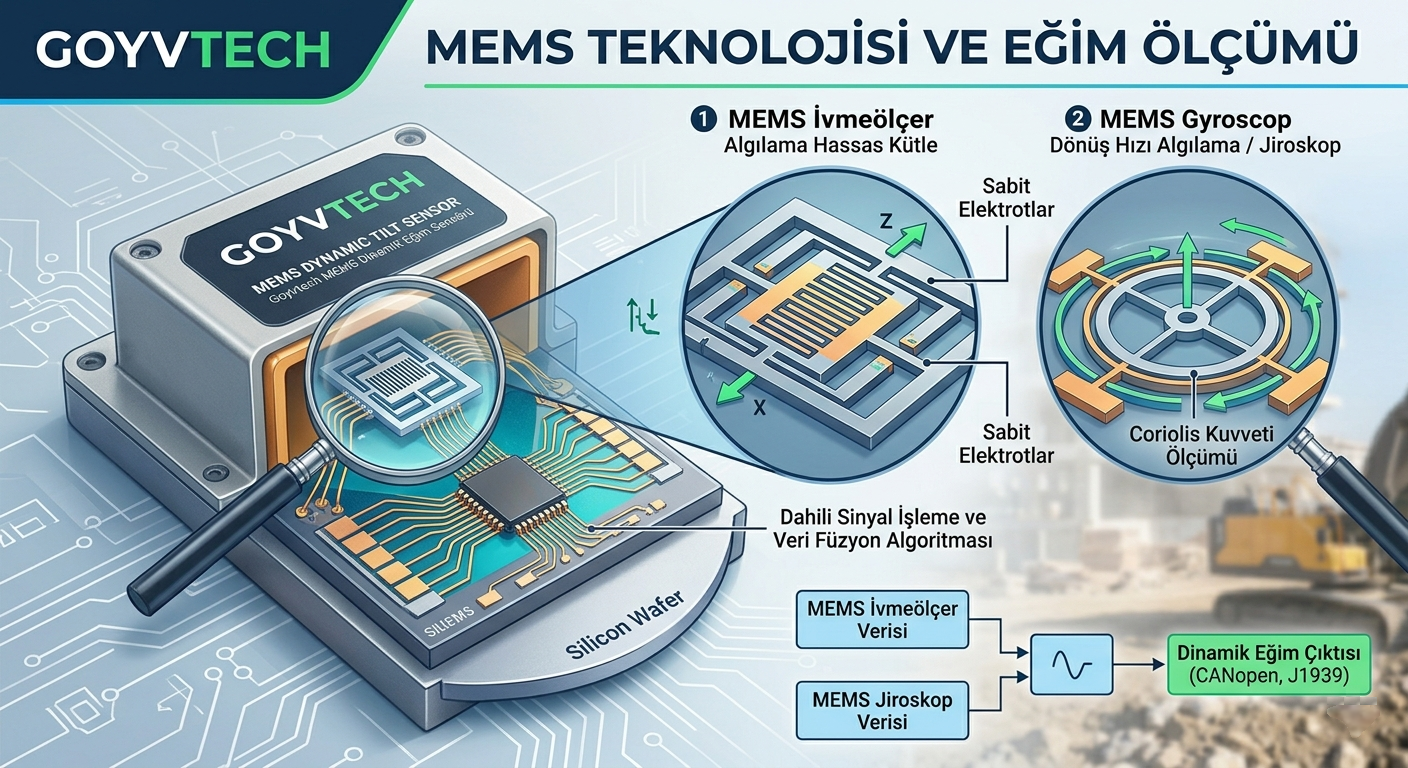
MEMS is the integration of micro-scale mechanical and electrical components onto a single silicon chip. In inclination sensors, this technology manifests as microscopic masses that detect gravitational acceleration and capacitive structures that measure the movement of these masses.
Why MEMS-Based Inclination Sensors?
Unlike traditional mechanical pendulum sensors, MEMS-based sensors offer the following advantages:
-
Compact Design: Thanks to their small size, they can be integrated even into the tightest spaces.
-
High Durability: The fact that moving parts are on a micro-scale increases the sensor's resistance to shocks and vibrations.
-
Low Power Consumption: Their energy efficiency makes them ideal for autonomous systems and battery-powered devices.
-
Integrated Signal Processing: They can directly convert data into digital outputs (CANopen, Modbus, etc.).
From MEMS to Dynamic Precision
In the dynamic inclination sensors we offer as Goyvtech, we support MEMS accelerometers with MEMS gyroscopes. This hybrid structure allows these micro-scale sensors to filter out external noise (vibration) and provide the most accurate angle even in the harshest conditions.
 LinkedIn
 X
X
 Facebook