



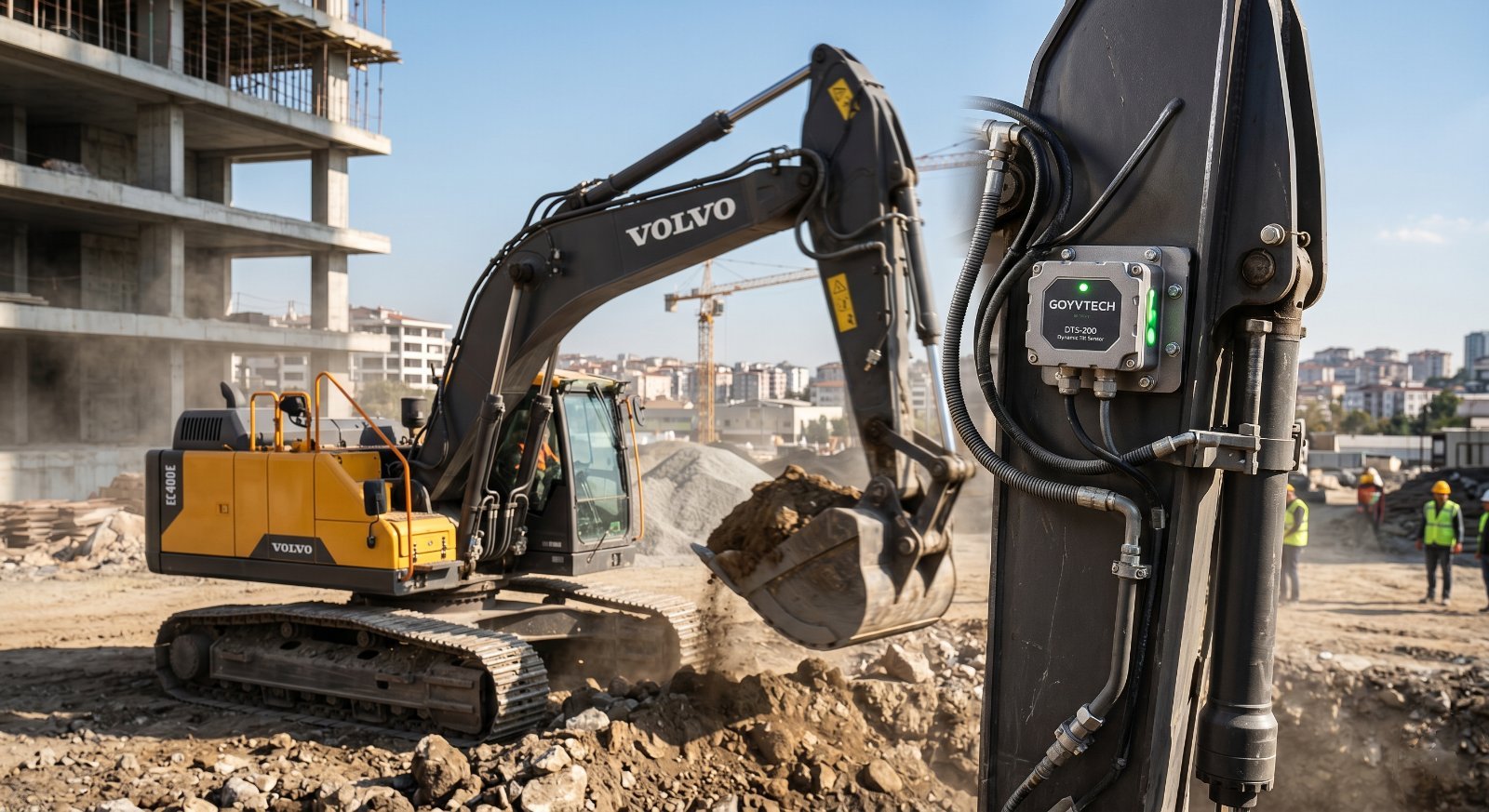
Precision in Inclination Measurement: Static or Dynamic? In the industrial world, "staying balanced" is not just a phrase; it is the foundation of operational success. Whether it is a massive crane boom or a precision agricultural machine, knowing the correct angle defines the fine line between safety and efficiency. However, not every tilt sensor performs the same in every environment.
What is Inclination (Tilt)? In its simplest definition, inclination is the angular deviation of an object relative to the vertical (plumb line) or horizontal axis. In the sensor world, this measurement is performed by referencing gravitational acceleration. However, when "motion" enters the equation, this simple definition turns into a complex engineering problem.
The Limit of Static Sensors: Vibration and Shock Traditional (static) tilt sensors provide excellent results while stationary. However, when an excavator is digging or a platform is moving on shaky ground, static sensors mistake these external accelerations for "tilt changes" and produce misleading data. This is the root cause of measurement errors at construction sites.
Dynamic Inclination Sensor: Accuracy Within Motion The Dynamic Inclination Sensors we offer as Goyvtech are designed to solve this complexity. So, how do these sensors make a difference?
-
MEMS Technology and Fusion: The accelerometer inside the sensor is supported by gyroscope data.
-
Noise Filtering: Advanced algorithms clear the "noise" data caused by the machine's vibration.
-
Real-Time Data: It provides the true angle without deviation, even while the machine is in motion, during sudden stops, or at moments of shock.
Conclusion: Why Should You Choose? If your system operates on a stable surface without vibration, static sensors are a cost-effective solution. However, if you are working in dynamic and harsh field conditions, dynamic solutions are not a luxury but a necessity to prevent time loss and safety risks caused by erroneous measurements. The dynamic inclination sensors we offer as Goyvtech integrate easily into existing systems by supporting communication protocols that are standard in heavy machinery, such as CANopen and SAE J1939.
 LinkedIn
 X
X
 Facebook